
Software-as-a-Service, or SaaS, refers to software that is hosted in a cloud computing environment managed by a third party rather than the user’s data centres, and is accessed via the internet. Because cloud environments typically have flexible resources that can be dialed up and down as needed, the SaaS model enables highly scalable computing capabilities. Additionally, the work needed to update and maintain the software is usually taken care of by the vendor rather than the business using the software.
Due to these factors, among others, SaaS solutions have become very popular among businesses and consumers alike, due to their convenience, fee structure, reliability, and scalability. Grand View Research (opens in new tab) estimates that in 2024 the Australian SaaS market generated US$10.7 billion in revenue. It is anticipated that this is on track to grow to US$19.9 billion by 2030 — a compound annual growth rate of 10.1%, demonstrating strong demand.
Case Study: Global Surf Industries and MTB Direct
The shift to cloud-based software delivery, or SaaS, is in full swing in Australia, from startups and SMEs all the way up to the biggest banks and government agencies. This has only been compounded with the shift to hybrid and remote work.
Local businesses like Sydney’s Global Surf Industries and Brisbane’s MTB Direct have been remote since day one. That agile approach has enabled them to focus on growing their respective businesses around Australia and overseas.
What Is SaaS (Software-as-a-Service)?
As a distinct cloud computing model, software-as-a-service (SaaS) is application software delivered to users over the internet. The software itself is hosted on cloud computing infrastructure, with users able to access and consume the software applications remotely over the internet. This typically involves the use of a web application accessed via an internet browser, such as Chrome or Firefox. However, some applications that can be installed on computers and mobile devices may also count as SaaS solutions if they’re synced with online versions of the software that are hosted in the cloud.
Unlike traditional software, which is often hosted on, and operates within, the user’s own computing hardware, SaaS applications are hosted on cloud infrastructure that is either operated by the SaaS provider or a third party. The use of multi-tenant cloud infrastructure means that each customers’ data is kept separate and secure from that of other customers. For SaaS applications that are used by a large number of people and organisations, it’s not uncommon for SaaS providers to host their applications on cloud infrastructure in multiple locations. This provides redundancy so that cloud-based applications can overcome disruptions such as network outages.
SaaS applications are priced in a substantially different way than that of traditional software. Instead of paying an up-front price for a perpetual licence plus additional fees for upgrades and updates, SaaS users generally pay for access to the software with an ongoing subscription. This approach has become a popular option for businesses, as it lets them class software fees as operating expenditure (OpEx) rather than capital expenditure (CapEx).
SaaS (Software-as-a-Service): What It Is & Examples
Case Study: me&u
Some of Australia and New Zealand’s top start-ups are SaaS businesses, delivering products to businesses and consumers via the internet.
For instance, Australian food ordering and payments platform provider me&u uses SaaS to help restaurants and pubs deliver digital menus to consumers. This gives venues a scalable way to provide personalised dining experiences and update menu items and deals more easily.
As a cloud-based distribution model, SaaS represents one of the three key categories of cloud computing services. In addition to SaaS, these are Infrastructure-as-a-Service, or IaaS, and Platform-as-a-Services, abbreviated to PaaS.
For instance, Slack is a SaaS product used by businesses for collaboration. One of the most popular business SaaS application categories is enterprise resource planning (ERP). Likewise, customer relationship management (CRM) solutions are also highly popular.
Here are some of the more widespread categories (opens in new tab) of business-focused SaaS applications today:
- Email: Web-hosted email applications have been around for a long time, and were in many cases among the first SaaS products adopted by businesses. Today, web-based email continues to be ubiquitous.
- ERP: ERP solutions typically connect or encompass different applications from across the business, including accounting, human resources, and supply chain.
- CRM: CRM solutions centralise customer information and data relating to interactions between a business and its customers. They can be used to provide insights into each prospective customer as well as transaction histories for existing customers.
- CMS: Content management systems handle the publishing and editing of content online. They are often used as the basis for ecommerce solutions as well as customer-facing websites for businesses.
- HR: Human resource management systems support the relationship lifecycle between a business and its workers. Capabilities typically include tools for contract labour, onboarding, payroll, and performance.
How Does SaaS Operate?
SaaS applications are hosted in cloud computing infrastructure, which means that instead of being accessed directly as software installed on a local computer or within a local organisational network, they are delivered and used over the internet.
Sometimes on-premises software may be hosted in private or hybrid cloud environments that are operated by the individual organisations consuming the solutions. However, this is distinct from SaaS, which is fully functional, cloud-hosted software that’s ready to use without the user needing to provide, or worry about, the hosting infrastructure, as this is managed by the vendor.
With SaaS, the software is hosted by the vendor so the user doesn’t have to worry about the maintenance and infrastructure management. Instead, the vendor manages any upgrades and updates themselves, with users getting access to those updates every time they log on to use the software.
Pricing models for SaaS solutions are typically based on a recurring subscription fee structure calculated on a per-user, per-month basis. This means the business using the solution only needs to pay for what it uses, and can easily scale up and down its usage depending on need. This is in contrast to traditional on-premises software solutions that the organisation pays an up-front price for, whether they are used or not.
Advantages of Software-as-a-Service
The continued growth and popularity of the SaaS model suggests that businesses see many advantages in using it over traditional software options. From the subscription-based pricing structure to the ease of maintenance and the money saved on hosting services, there are several considerable upsides to SaaS solutions, including:
- Scalability: Cloud infrastructure is known for its ability to scale up and down depending on user requirements. Because SaaS is cloud-based, it also has this scalability, letting businesses dynamically use as much or as little of the solution’s services as needed.
- Speedy set up: With SaaS applications, users don’t need to install any software or manage any special infrastructure, making implementation comparatively fast and easy.
- Lower capital investment: Another reason why SaaS solutions are quick to implement is that businesses don’t need to pay a large up-front licence fee, instead paying for the service on a monthly, per-use basis.
- Access anywhere: SaaS applications are accessible from anywhere with an internet connection, making them easy to use from any number of locations, at any time, supporting more flexible work styles.
- Real-time data compliance: Software vendors provide updates to all subscribers when new, relevant legislation is passed. For example, financial software may be updated to comply with new Australian Accounting Standards when they are passed and come into effect.
- Easy to manage: Not only are SaaS solutions typically designed to be highly user-friendly, they are also easy to maintain, since the work of upgrading and updating the software is handled by the vendor.
- Reliable: With appropriate service level agreements (SLAs), SaaS applications can offer businesses substantially more reliable software than on-premises options. Much of this has to do with the resilience and redundancy provided by SaaS data centre infrastructure.
Case Study: Master Builders Victoria and Kieser
Entrepreneurs at Australia and New Zealand’s top technology start-ups choose SaaS for their business software thanks to its unrivalled flexibility and scalability. Regular updates also mean the user experience is constantly being refined — which ensures high adoption among teams.
Challenges and Risks of Software-as-a-Service
Although SaaS solutions come with numerous benefits over traditional, on-premises solutions, there are also some things to be aware of when using them. For instance, using software over the internet instead of on a local server requires a rethink of best practice when it comes to data management. Here are some of the key considerations when using SaaS:
- Connectivity needs: SaaS is distributed and consumed over the internet, which means an active internet connection is needed for full functionality of most software. However, some functionality may remain if the user has a cached, or offline, version of the application.
- Regional network infrastructure: While Australian cities typically enjoy fast internet, bandwidth availability can vary from region to region, depending on the existing internet infrastructure available.
- Data safety: In some ways, good quality SaaS solutions can provide greater levels of data security than many on-premises applications, because vendors adhere to stringent cloud computing infrastructure standards, yet users may have less control over where data is stored.
- Latency lag: Latency is the time it takes for a digital signal to travel to and from a SaaS user’s local computer to the cloud data centre where the software application is hosted. In some instances, this may lead to slower responsiveness in SaaS apps compared to on-premises apps.
- Vendor decisions: While a key upside of SaaS solutions is that they are upgraded automatically by the vendor, this may also mean that vendors can decide to send through unwelcome updates or upgrades that users may not want, regardless of user need.
Comparisons With Other Cloud Service Models:
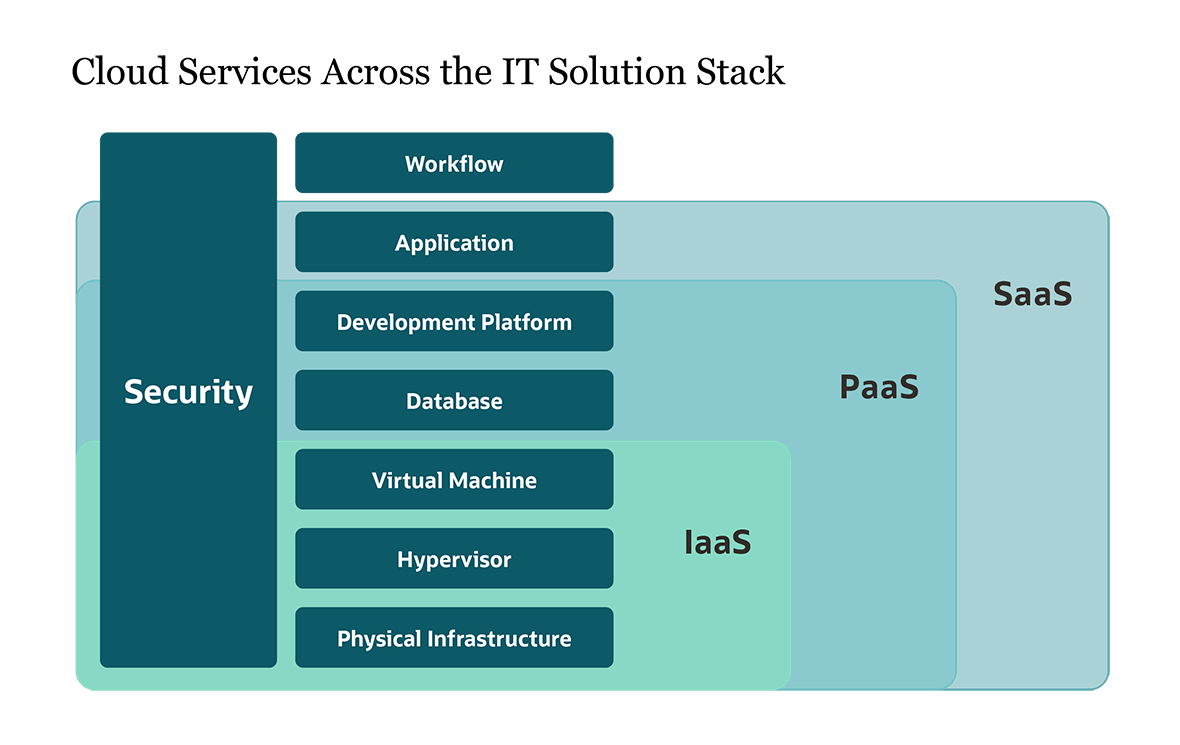
SaaS is just one kind of cloud service model. Two other key cloud service models are Infrastructure-as-a-Service (IaaS) and Platform-as-a-Service (PaaS), both of which offer businesses cloud services, but in different ways and with different capabilities. IaaS, as the name suggests, provides the infrastructure for a business to host their applications or services in the cloud. PaaS, on the other hand, provides a cloud-based platform designed for cloud-native solutions and services. By comparison, SaaS delivers complete software solutions from the cloud, including the application, the infrastructure, the platform, and the associated maintenance.
Infrastructure-as-a-Service (IaaS)
IaaS represents the most basic way for businesses to host their applications or services in the cloud. Whether they are on-premises solutions that are migrated to a cloud environment via a ‘lift-and-shift (opens in new tab)’ approach or traditional solutions owned and operated by the business deployed directly to cloud infrastructure, IaaS provides the environment needed for organisations to move applications out of their own on-premises environments. In that sense, IaaS gives businesses the ability to use somebody else’s infrastructure instead of their own to host software applications.
Platform-as-a-Service (PaaS)
Unlike IaaS, PaaS is a cloud computing model where a provider delivers a platform for software application development and deployment over the internet. With PaaS environments, users don’t need to worry about operating systems or the computing platforms on which the software runs, as these are included in the platform itself. The PaaS model allows the use of application programming interfaces (opens in new tab) (APIs) to integrate their legacy computing environments with a PaaS, or even a SaaS, environment. This means that on-premises apps can run in hybrid cloud or private cloud environments.
Tap Into the Power and Flexibility of SaaS With NetSuite ERP
NetSuite ERP is popular with startups, mid-market and large enterprises around Australia, across a range of industries from retail to manufacturing and wholesale distribution.
Your business can also gain the benefits of an industry-leading SaaS solution with NetSuite ERP, an all-in-one, AI-powered, cloud business management solution that helps organisations operate more effectively by automating core processes and providing real-time visibility into operational and financial performance.
Being a cutting-edge SaaS platform, NetSuite provides organisations with a single, integrated suite of tools for managing accounting, order processing, inventory management, production, supply chain, and warehouse operations, delivering visibility into data from across the business.
SaaS (Software-as-a-Service) FAQs
What best defines SaaS?
Software-as-a-Service (SaaS) is defined as a distinct form of cloud computing where software applications are delivered to users over the internet, usually via a web app. Unlike traditional on-premises software, which is hosted in infrastructure operated by the organisation using the application, SaaS is hosted in cloud computing infrastructure.
What is an example of a SaaS?
The term SaaS can be applied to most solutions that are cloud-hosted and delivered or consumed via the internet. These include web-based email services such as Gmail. SaaS applications for businesses can come in many categories, including enterprise resource planning (ERP) and customer relationship management (CRM).
What is considered a SaaS company?
Any software vendor that provides cloud-based solutions for individuals or businesses over the internet may be considered a SaaS company. With Gmail, among other cloud-based products, for instance, Google can be considered a SaaS company, since it provides solutions via the internet which are hosted on cloud infrastructure.